Showing posts with label Solomon Senenmut Out of Egypt prophet Nahum Shaphan C. Seow. Show all posts

Friday, November 6, 2015

Hebrew Bible as an Inspiration for Ancient Greek Philosophy


by

Damien F. Mackey


This article follows up my theme that the Church Fathers were right about the Hebrew origins of mainstream Greek philosophy.


Introduction


In previous articles I have supported


               i.          St. Clement of Alexandria’s view that Plato’s writings took their inspiration from the Hebrew Moses, and

             ii.          St. Ambrose’s belief that Plato had learned from the prophet Jeremiah in Egypt; a belief that was initially taken up by St. Augustine, who added that

           iii.          Greek philosophy generally derived from the Jewish Scriptures.


And, though St. Augustine later retracted his acceptance of St. Ambrose’s view, realising that it was chronologically impossible for Jeremiah (c. 600 BC) to have met Plato anywhere, considering the c. 400 BC date customarily assigned to Plato, I have, on the other hand, looked to turn this around by challenging the conventional dates.

From the Book of Jeremiah we learn that Jeremiah and Baruch went together to Egypt. So this Baruch, whom tradition also identifies as Zoroaster, would be a possible candidate to consider for St. Ambrose ‘Plato who was contemporaneous with Jeremiah in Egypt’.

Again, much of Plato’s most famous work, The Republic, with its themes of justice and righteousness, could have arisen, I suggest, from the intense dialogues of the books of Jeremiah and Job of identical themes. I shall discuss this further below.


Saint Justin Martyr


Moreover, St. Justin Martyr had, even earlier than the above-mentioned Church Fathers, espoused the view of the Greek philosophers borrowing from the biblical Hebrews. And Justin Martyr too, had, like Plato, written an Apology, in Justin’s case also apparently (like Plato) in regard to a martyrdom. So we read (http://beityahuwah.blogspot.com/2005/08/plato-stole-his-ideas-from-):


Plato Stole his ideas from Moses: True or False ….


The belief that the philosophers of Greece, including Plato and Aristotle, plagiarized certain of their teaching from Moses and the Hebrew prophets is an argument used by Christian Apologists of Gentile background who lived in the first four centuries of Christians.


My comment: I would like to take this a stage further. Just as I have argued in my


Solomon and Sheba


that the supposed Athenian statesman and lawgiver, Solon, was in fact a Greek appropriation of Israel’s wise lawgiver, Solomon, so do I believe that the primary ‘Ionian’ and ‘Greek’ philosophers of antiquity were actually Greek appropriations of Hebrew sages and prophets. Regarding the supposed “Father of Philosophy”, Thales, for instance, see my:


and, for Pythagoras:


Hebrew Foundations of Pythagoras


Now, getting back to the Church Fathers:


Three key figures who presented this thesis are Justin Martyr “The most important second­ century apologist” {50. Grant 1973}, Titus Flavius Clemens known as Clement of Alexandria “the illustrious head of the Catechetical School at Alexandria at the close of the second century, was originally a pagan philosopher” (11, Robert 1857) and is renowned as being possibly the teacher of Origen. He was born either in Alexandria or Athens {Epiphs Haer, xxii.6}. Our final giant who supports this thesis is Eusebius of Caesarea known as the father of Church history. Each of these in their defense of the Christian faith presented some form of the thesis that the philosophers of Greece learned from the prophets of Israel. Our interest in this paper is on the arguments of the earliest of these writers, Justin Martyr. He represents the position of Christian apology in the middle of the second century, as opposed to the later Clement of Alexandria and the even later Eusebius of Caesarea.

In light of the stature and the credibility of these three Church Fathers even if the idea that Plato learned from Moses seems far fetched we would do well to take a closer look at the argument and the evidence presented by such men of stature. Justin was a philosopher who came from a pagan background. He issued from Shechem in Palestine. He was a marvelous scholar in his own right well read and well qualified to make informed judgments in the arena of philosophy.

Our purpose is to briefly look at the theses presented by Justin Martyr and to try to discern the plausibility of the thesis.


Justin Martyr and the line Plato took from Moses.


My comment on this section: If the great Plato is to be restored as a biblical sage, as I think eventually he must be, then this would be not so much a case of Greeks plagiarising the Scriptures as of a biblical wise man (the original Plato) keeping alive the Mosaïc Law and Tradition.

The article continues with a biography of Justin Martyr:


Justin Martyr was a prolific second century Apologist. He was born in Flavia Neapolis (Shechem) in Samaria. Well known for the local Samaritan temple on Mount Gerizim and a temple built by Hadrian to Zeus Hypsistos. He later passed through Stoicism and the way of Aristotle’s disciples the Peripatetics and was rejected as unqualified to study Pythagoreanism and finally he met a Platonist with whom he advanced in his studies. To him the goal of Platonism was “the vision of God”. One day he met a Christian on the beach and was converted to the faith. He did not become a priest or bishop but took to teaching and defending the faith.

Text

He wrote many works and many more bear his name. However modern scholarship has judged that of the many works that bear his name only three are considered genuine. These are 2 Apologies and the Dialogue with the Jew Trypho. They are preserved in one manuscript of the year 1364 (Cod Par, gr. 450).

Language

Justin wrote in Greek, and right in the middle of the period of philosophy called Middle Platonism. The book in which he outlines his thesis that Moses and the prophets were a source for the Greek Philosophers is his first Apology. It is dated to 155-157 BC and was addressed to “The Emperor Titus Aelius Hadrianus Antonius Pius Caesar Augustus, and the sons Verissimus, philosopher, philosopher, and Lucius” Grant (52, 1973).


My comment: I would seriously contest these conventional dates for Imperial Rome, given my view that the so-called ‘First’ and ‘Second’ Jewish revolts against Rome, separated by more than half a century, were the one and same revolt of 70 AD. See my:


I Am Barabbas


It is here that Justin makes a most interesting and intriguing statement rallying Plato to the side of Moses and Isaiah, in the eyes of the son of the Emperor whom he calls philosophers.


The article continues with the writings of Justin Martyr:


Context

Grant (1973) believes the reason which triggered the Apology was the martyrdom of Polycarp in 156 AD and the injustice of it during the bishopric of Anicetus. Even as this martyrdom and its report may have spurred Justin on to write so it had been that it was on seeing the fortitude of the Christian martyrs which had disposed him favorably towards the faith (Ap 2.12.1). ….

In the Apology 1 Justin gives the reason for his writing

“I, Justin, the son of Priscus and grandson of Bacchius, natives of Flavia Neapolis in Palestine, present this address and petition on behalf of those of all nations who are unjustly hated and wantonly abused; my self being one of them” (Apology 1 chap).

The Apology 1 is divided into 60 chapters. The translation we are using is that of the Ante Nicene Fathers and can be seen at www.ccel.org

The topics covered are many. He starts in chapter 2 by demanding justice, he requires that before the Christians are condemned they should be given a fair trial to see if they have committed any crimes or not. They should not be condemned merely for being Christian. He covers many subjects including: the accusation Christians were Atheists, faith in God; the Kingdom of Christ; God’s service; demonic teachings; Christ’s teachings and heathen analogies to it; non Christian worship; magic; exposing children, the Hebrew prophets and their prophecies about Christ, types of prophetic words from the Father, the Son and the Holy Spirit. This brings us to about chapter 38. At this point Justin begins to cover the issue of determinism and free will. He argues that although the future was prophesied it does not mean everything is determined according to fate and man has no responsibility for he has no choice. Rather he points to Moses revealing God’s choice to Adam “Behold before thy face are good and evil: choose the good”. (Apol 1 44) And he quotes lsaiah’s appeal to Israel to wash and be clean and the consequences of doing so or not doing so. The consequences of disobedience are that the sword would devour Israel. Justin picks up on the statement regarding the sword and argues that it is not a literal sword which is referred to but “the sword of God is a fire, of which those who choose to do wickedly will become the fuel” (Apol 1 44). Justin having appealed to Moses and Isaiah as a warning to the Roman rulers now appeals to one with whom they are more familiar, Plato the philosopher, to support his case that man is free to choose good or evil. It is here that Justin makes a most interesting and intriguing statement rallying Plato to the side of Moses and Isaiah, in the eyes of the son of the Emperor whom he calls philosophers.

And so, too, Plato, when he says, “The blame is his who chooses, and God is blameless” took this from the prophet Moses and uttered it.

For Moses is more ancient than all the Greek writers. And whatever both philosophers and poets have said concerning the immortality of the soul, or punishments after death, or contemplation of things heavenly, or doctrines of the like kind, they have received such suggestions from the prophets as have enabled them to understand and interpret these things. And hence there seem to be seeds of truth among all men; but they are charged with not accurately understanding [the truth] when they assert contradictories.

…. He appears to be making the claim that Plato who has “exerted a greater influence over human thought than any other individual with the possible exception of Aristotle” (Demos, 1927.vi) was dependent for his understanding of freewill and responsibility on Moses. The saying “the blame is his who chooses, and God is blameless (Aitia helomenou Theos d’ anaios) {Joann. Mdcccxlii, 224}” was taken from Moses by Plato and uttered it {eipe}”.

[End of quote]


Plato and Job


The combined story of Job and his alter ego, Tobias, son of Tobit


Job’s Life and Times


has had a profound influence upon worldwide literature, both ancient and modern. To give just one example, see my:


And, as already implied, I believe that this biblical story has also had a huge influence upon ancient (supposedly Greco-Roman) philosophy, which, however, significantly alters the original version. For, whilst there can be a similarity in thought between Plato and, for example, the Book of Job, the tone may be quite different. Plato’s Republic, and his other dialogues such as Protagoras and Meno, brilliant though they may be in places, when compared with the intense atmosphere of the drama of the Book of Job, come across sometimes as a bit like a gentlemen’s discussion over a glass of port. W. Guthrie may have captured something of this general tone in his Introduction to Plato. Protagoras and Meno (Penguin, 1968), when he wrote (p. 20, emphasis added):


… a feature of the conversation which cannot fail to strike a reader is its unbroken urbanity and good temper. The keynote is courtesy and forbearance, though these are not always forthcoming without a struggle. Socrates is constantly on the alert for the signs of displeasure on the part of Protagoras, and when he detects them, is careful not to press his point, and the dialogue ends with mutual expressions of esteem. ….


[End of quote]


Now compare this gentlemanly tone with Job’s ‘How long will you torment me, and break me in pieces with words? These ten times you have cast reproach upon me; are you not ashamed to wrong me?’ (19:1-3), and Eliphaz’s accusations of the holy man: ‘Is not your wickedness great? There is no end to your iniquities [which supposed types of injustice on the part of Job Eliphaz then proceeds to itemise]’ (22:5).

In Plato’s dialogues, by way of complete contrast, we get pages and pages of the following sort of amicable discussion as taken from The Republic (Bk. 2, 368-369):


[Socrates] ‘Justice can be a characteristic of an individual or of a community, can it not?’

[Adeimantus] ‘Yes’.

[Socrates] ‘And a community is larger than an individual?’

[Adeimantus] ‘It is”.

[Socrates] ‘We may therefore find that the amount of justice in the larger entity is greater, and so easier to recognize. I accordingly propose that we start our enquiry …’.

[Adeimantus] ‘That seems a good idea’, he agreed. ….


Protagoras, the well-known Sophist, is famous for his maxim “Man is the measure of all things, of those that are that they are, and of those that are not that they are not” (Plato’s Theaetetus, 152), a philosophy that has its severe limitations:


The Futile Aspiration to Make ‘Man the Measure of All Things’


https://www.academia.edu/8494268/The_Futile_Aspiration_to_Make_Man_the_Measure_of_All_Things_


However, this maxim may actually be, according to my estimation, based upon the philosophy of the elderly Eliphaz of the Book of Job. For his possible identity in the Book of Tobit, see my:


https://www.academia.edu/12159726/Friends_of_the_Prophet_Job._Part_One_Eliphaz_the_Temanite


Though Eliphaz was by no means a Sophist along the Greek lines, he was, like Protagoras with Socrates, largely opposed to his opponent’s point of view. And so, whilst the God-fearing Eliphaz would never have uttered anything so radical or atheistic as “man is the measure of all things”, he was however opposed to the very Job who had, in his discussion of wisdom, spoken of God as ‘apportioning out by measure’ all the things that He had created (Job 28:12, 13, 25).


Whilst Protagoras is but a pale ghost of the biblical Eliphaz, some of the original lustre does still manage to shine through, nonetheless, as with Protagoras’s claim that knowledge, or wisdom, was the highest thing in life (Protagoras, 352C, D) (cf. Eliphaz in Job 22:1-2). And Guthrie adds that Protagoras “would repudiate as scornfully as Socrates the almost bestial type of hedonism advocated by Callicles, who says that what nature means by fair and right is for the strong man to let his desires grow as big as possible and have the means of everlastingly satisfying them” (op. cit., p. 22).


Eliphaz, Job-Tobias’s father-in-law according to my reconstructions, appears, from this, to have later been re-invented as Protagoras the Sophist from Abdera, as a perfect foil to Socrates (with Job’s other friends also perhaps emerging in the Greek versions re-cast as Sophists). Protagoras stated, somewhat like Eliphaz, that he was old enough to be the father of any of them. “Indeed I am getting on in life now – so far as age goes I might be the father of any one of you …” (Protagoras, 317 C). That Eliphaz was old is indicated by the fact that he is the first to address Job and that he also refers to men older than Job’s father (Job 15:10). Now, just as Fr. R. MacKenzie (S.J.) in his commentary on “Job”, in The Jerome Biblical Commentary, tells of Eliphaz’s esteem for, and courtesy towards, Job (31:23):


Eliphaz is presumably the oldest of the three and therefore the wisest; he is certainly the most courteous and the most eloquent. He has a genuine esteem for Job and is deeply sorry for him. He knows the advice to give him, the wisdom that lays down what he must do to receive relief from his sufferings.

[End of quote]


so does Guthrie, reciprocally (I suggest), say: “Protagoras – whom [Socrates] regards with genuine admiration and liking” (op. cit., p. 22).

But, again, just as the righteous Job had scandalised his friends by his levity, according to St. Thomas Aquinas (“Literal Exposition on Job”, 42:1-10), “And here one should consider that [the young] Elihu had sinned out of inexperience whereas Job had sinned out of levity, and so neither of them had sinned gravely”, so does Guthrie use this very same word, “levity”, in the context of an apparent flaw in the character of Socrates (ibid., p. 18):


There is one feature of the Protagoras which cannot fail to puzzle, if not exasperate, a reader: the behaviour of Socrates. At times he treats the discussion with such levity, and at other times with such unscrupulousness, that Wilamowitz felt bound to conclude that the dialogue could only have been written in his lifetime. This, he wrote, is the human being whom Plato knew; only after he had suffered a martyr’s death did the need assert itself to idealize his character.

[End of quote]


Job’s tendency towards levity had apparently survived right down into the Greek era. Admittedly, the Greek version does get much nastier in the case of Thrasymachus, and even more so with Callicles in Plato’s Gorgias, but in The Republic, at least, it never rises to the dramatic pitch of Job’s dialogues with his three friends.

Here is that least friendly of the debaters, Thrasymachus, at his nastiest (Republic, Bk. I, 341):


[Socrates] Well, said I, ‘so you think I’m malicious, do you Thrasymachus?’

[Thrasymachus] ‘I certainly do’.

[Socrates] ‘You think my questions were deliberately framed to distort your argument?’

[Thrasymachus] ‘I know perfectly well they were. But they won’t get you anywhere; you can’t fool me, and if you don’t you won’t be able to crush me in argument’.

[Socrates] ‘My dear chap, I wouldn’t dream of trying’, I said ….


Socrates and Plato are similarly (like the Sophists) watered-down entities by comparison with the Middle Eastern originals. Such is how the Hebrew Scriptures end up when filtered through the Greeks, [and, in the case of Plato, perhaps through Egypt before the Greeks, hence a double filtering]. Even then, it is doubtful whether the finely filtered version of Plato that we now have could have been written by pagan Greeks. At least some of it seems to belong clearly to the Christian era, e.g. “The just man … will be scourged, tortured, and imprisoned … and after enduring every humiliation he will be crucified” (The Republic, Bk. 2, 362).


I submit that this statement would not likely have been written prior to the Gospels.


Friday, July 31, 2015

Lying Cretans and Unknown Gods: Allusions to Epimenides in the New Testament

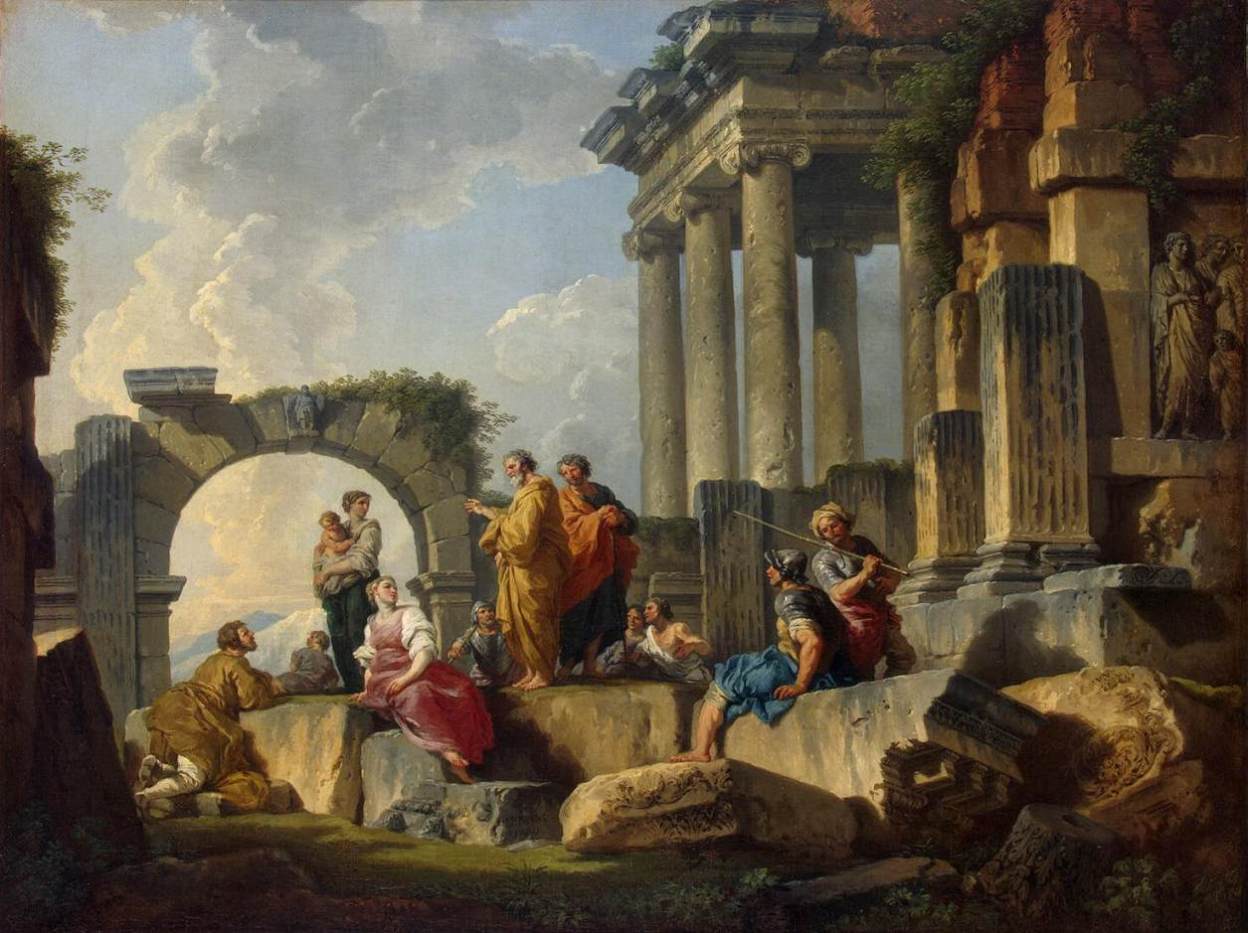
Apostle Paul Preaching upon the Ruins by Giovanni Paolo Panini (1744)


[The AMAIC is generally inclined to give precedence to the Hebrews, as having influenced the pagan Greeks – and not the other way around]


….

Only lately have I really begun to appreciate how much literary allusion there is in the New Testament. The books of the Christian canon were not written in a vacuum — its authors were literate, educated Greek speakers who drew heavily upon other writings from both the Jewish and Greek cultural spheres. My unfamiliarity with most ancient Greek literature has made me uncomfortably aware of how much context I am missing when I read the New Testament. As I explore the sources that influenced early Christian writing, I plan on blogging about them here. Today, I begin with Epimenides.
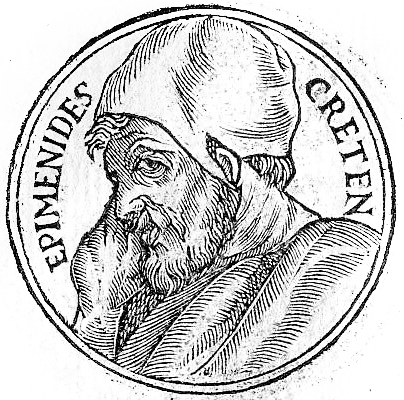
Illustration of Epimenides from %22Promptuarii Iconum Insigniorum%22 by Guillaume Rouillé

Who was Epimenides?

Epimenides was a Greek poet and seer from Knossos on the isle of Crete. He lived in the sixth century BCE and became known as one of the “Seven Wise Poets” in ancient Greece.
Among other things, he was famous as the original Rip Van Winkle. According to widely-known legends, he once lay down for a nap in a cave while searching for a lost sheep. When he woke up, it was some fifty years later, and scarcely nothing was recognizable to him. He soon gained renown as a “favourite of heaven” and was thought to have received divine revelation from Zeus during his sleep.
Epimenides was also a priest of the cult of Zeus on Crete, acquainted with the famous lawgiver Solon, and reputed to survive on almost no food. He was known as a seer or prophet, but according to Aristotle, he only practised divination about the past, not the future.

The Deliverance of Athens

There is a particular episode from the life of Epimenides related by the biographer Diogenes Laertius that is of some interest. According to this story, Athens was being attacked by pestilence, and after consulting with the Oracle of Delphi, the Athenians sent a ship to Crete to ask for the help of Epimenides.
Epimenides agreed to help the Athenians. He came to Athens and brought some sheep to the Areopagus — an important location in Athens, also known as Ares Rock or Mars Hill. He released the sheep and allowed them go to where they pleased. Wherever a sheep lay down, Epimenides had the spot marked so that sacrifices could be made to the unknown local divinity there. Epimenides’ remedy worked, and Athens was delivered from its scourge. Thus, from that day onward, visitors to Athens would find altars to unknown gods around the city.
The Aeropagus in Athens today (source: Wikipedia)

“It was one of them, their very own prophet…”

The Epistle to Titus is one of the Pastoral Epistles, ostensibly written by Paul the apostle, but generally recognized as a pseudepigraphic work since the late 19th century.¹ It is addressed to its namesake Titus, a companion of Paul’s in Galatians and 2 Corinthians who appears here in the role of a bishop to the churches in Crete. (I will leave aside interpretation matters, such as whether the addressee in the Epistle to Titus is meant to represent an actual individual or not.) The writer warns Titus about opponents spreading lies in the form of false doctrines on Crete. He emphasizes his point with an interesting quotation in Titus 1:12–13a:
It was one of them, their very own prophet, who said, “Cretans are always liars, vicious brutes, lazy gluttons.” That testimony is true.
The writer seems to expect his readers to be familiar with the quotation, so he does not provide a source. However, several early Christian writers, including Clement of Alexandria, John Chrysostom, Epiphanius, and St. Jerome, identified Epimenides as its source. These writers felt obliged to identify explain the quote’s origin in order to address the reasons why Paul would authoritatively cite a pagan prophet (and indeed call him a prophet in the first place), smoothing over any theological qualms some readers might have.
Since none of Epimenides’ works have survived to the modern age, it is mainly thanks to the patristic writers that we know the origin of Titus 1:12. Its exact context and the title of the work in question have long been a mystery, however (Jerome called it Oracles of the Poet of Crete, while John Calvin referred to it as Concerning Oracles). One possibility regarding its context is suggested by another ancient poet, Callimachus, who paraphrased Epimenides in his own Hymn to Jupiter.
The Cretans, prone to falsehood, vaunt in vain,And impious! built thy tomb on Dicte’s plain;
For Jove, th’ immortal king, shall never die,
But reign o’er men and Gods above the sky.
This poem addresses a popular idea frowned upon by the cult of Zeus — namely that Zeus had once lived as a king on earth, and then died. In fact, there was even a tomb on Crete that some claimed was that of Zeus. Thus, the Cretans were to be condemned as liars for spreading false myths about Zeus, much as they were accused of doing with respect to the God of Christianity in the Epistle to Titus. The point is not necessarily to paint all Cretans this way. Rather, as Lawlor puts it, it was “a sort of rhetorical generalization based on a single fact” — an allusion to a specifically religious heresy.²
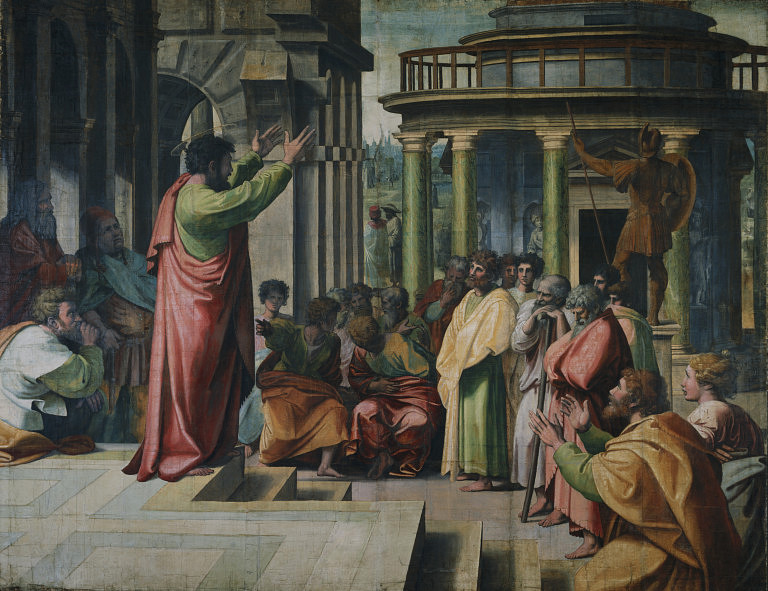
St. Paul Preaching in Athens, by Raphael (1515)

“As even some of your poets have said…”

There appears to be one other quotation of Epimenides in the New Testament, and it comes from the same work of his — the same passage, in fact. However, it was largely unknown until fairly recently, although many of the clues were there.
Shortly after the turn of the 20th century, a professor named Rendel Harris discovered a longer quotation from Epimenides’ Minos and Rhadamanthus in the Syrian lectionary Garden of Delights and in a 9th-century commentary on Acts by Isho’dad of Merv — both dependent on a now-lost work by Theodore of Mopsuestia (c. 400 CE). Harris found that the passage (quoted in Syriac) could be back-translated into good hexameter Greek poetry. An English translation is as follows:
A grave has been fashioned for thee, O holy and high One,The lying Cretans, who are all the time liars, evil beasts, idle bellies;
But thou diest not, for to eternity thou livest and standest,
For in thee we live and move and have our being.
Line two in Greek is identical to the quotation in Titus 1:12. However, the passage was quoted by Isho’dad as the source of Acts 17:28a. Let’s look at that verse in context:
While Paul was waiting for them in Athens… some Epicurean and Stoic philosophers debated with him. Some said, “What does this babbler want to say?” Others said, “He seems to be a proclaimer of foreign divinities.” …So they took him and brought him to the Areopagus and asked him, “May we know what this new teaching is that you are presenting? It sounds rather strange to us, so we would like to know what it means.” Now all the Athenians and the foreigners living there would spend their time in nothing but telling or hearing something new.
Then Paul stood in front of the Areopagus and said, “Athenians, I see how extremely religious you are in every way. For as I went through the city and looked carefully at the objects of your worship, I found among them an altar with the inscription, ‘To an unknown god.’ What therefore you worship as unknown, this I proclaim to you. The God who made the world and everything in it, he who is Lord of heaven and earth, does not live in shrines made by human hands, nor is he served by human hands, as though he needed anything, since he himself gives to all mortals life and breath and all things. From one ancestor he made all nations to inhabit the whole earth, and he allotted the times of their existence and the boundaries of the places where they would live, so that they would search for God and perhaps grope for him and find him—though indeed he is not far from each one of us. For ‘In him we live and move and have our being’; as even some of your own poets have said, ‘For we too are his offspring.’
We now understand more clearly the scene with which we are presented in Acts 17 — which should probably be understood as a literary creation rather than a strict historical account.³ Paul visits the great city of Athens and is taken by Epicurean and Stoic philosophers to debate with them on the famous hill where philosophers give speeches and magistrates conduct legal matters. Paul sees the altars to unknown gods and remembers that their existence is credited to the wise poet Epimenides, who delivered Athens from a plague. But whereas Epimenides served Zeus first and foremost, Paul proclaims the Jewish God as the unknown god and true object of the Athenians’ piety, using a quotation from Epimenides to drive his point home.
(Paul then employs a quotation by the poet-philosopher Aratus, “For we too are his offspring”, from the poem Phaenomena, as a segue to the next part of his speech.)
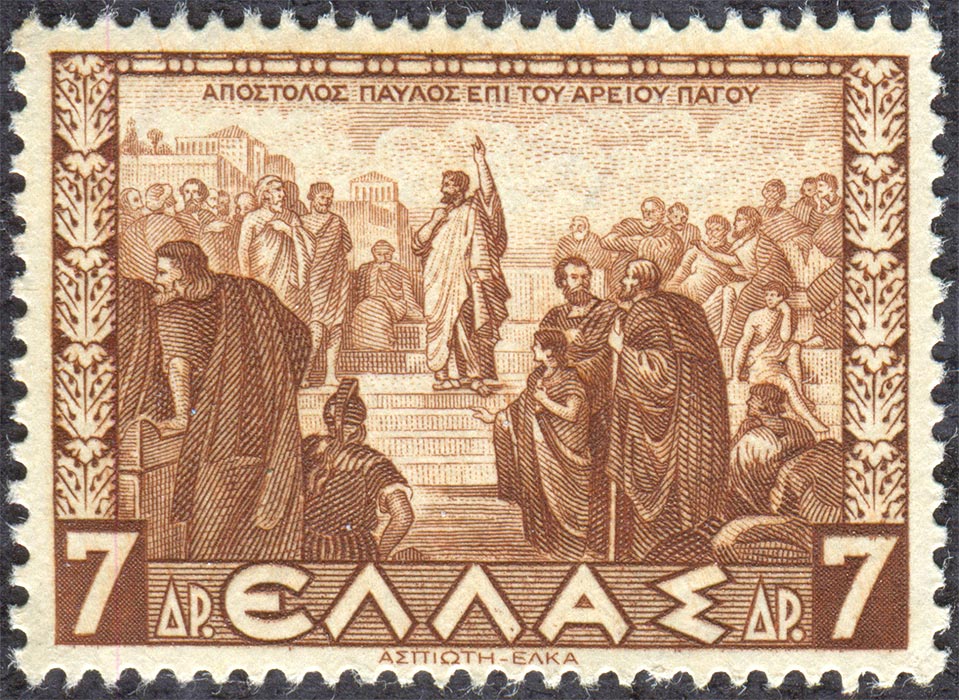
St. Paul preaching to the Athenians (Greek postage stamp, 1937)

Other Remarks

It is difficult to say whether other ancient Christian writers noticed this quotation but did not mention it. John Chrysostom mistakenly attributed the Aratus quote in Acts 17:28b to Epimenides in his Homily on Titus. Epiphanius, Jerome, and Boccaccio all discussed both the Acts passage and the Titus quotation in conjunction with each other, suggesting some awareness of a connection.
The fact that the same passage by Epimenides could be the source of quotations in two disparate New Testament works is significant and has not gone unnoticed. Nicklin, writing nearly a century ago, thought it was strong evidence for common authorship of Titus and Acts. (He identified the author as St. Paul himself, though few if any scholars would agree today.) Nicklin also believed that the word “poets” in the plural hinted at an earlier revision or source in which Acts 17:28a was explicitly portrayed as a quotation. More recently, David Trobisch has argued for the existence of a single second-century editor behind the New Testament canon, and unexpected intertextual links could in theory be the work of such an editor.⁴
I should note that although the identification of the quote in Acts 17:28a with Epimenides is doubted by a few scholars, it seems to have received broad acceptance. The Acts Seminar Report calls it a “probable allusion” to Epimenides. The NRSV and some other translations put the line in quotation marks to indicate someone is being quoted. The Jerusalem Bible and the NIV both explicitly attribute the line to Epimenides in a footnote.
James Buchanan Wallace, in his monograph Snatched into Paradise (2 Cor 12:1–10), sees certain parallels between the story of Epimenides and the cave and Paul’s own (claimed) experience of heavenly enlightenment.⁵ Could it be that the author of Acts, either deliberately or subconsciously, drew upon legends of other Greek seers and visionaries in describing the events of Paul’s life beyond the Areopagus confrontation?

References

  1. For a detailed discussion on the authorship of the Pastoral epistles and a history of scholarship thereupon, see Bart Ehrman, Forgery and Counterforgery: The Use of Literary Deceit in Early Christian Polemics, 2012, pp. 192–217.
  2. H. J. Lawlor, “St. Paul’s Quotations from Epimenides”, The Irish Church Quarterly, Vol. 9, No. 35 (Jul., 1916), p. 193.
  3. According to the conclusions of the Acts Seminar, Paul’s trip to Athens in Acts does not match anything from Paul’s letters and is likely fictitious. See Dennis E. Smith and Joseph B. Tyson, editors, Acts and Christian Beginnings: The Acts Seminar Report, 2013, Kindle loc. 3852.

Further Reading

  • Diogenes Laertius, Lives of Eminent Philosophers, 10.109–115.
  • T. Nicklin, “Epimenides’ Minos”, The Classical Review, March 1916.
Readers might also have heard of the Epimenides Paradox, a problem in logic inspired by the statement that “all Cretans are liars”, made by someone who himself is a Cretan. A wonderful exploration of this and similar ideas can be found in Gödel, Escher, Bach: An Eternal Golden Braid by Douglas R. Hofstadter.

Wednesday, July 29, 2015

Ovid’s Metamorphoses and the Gospel According to Hermes


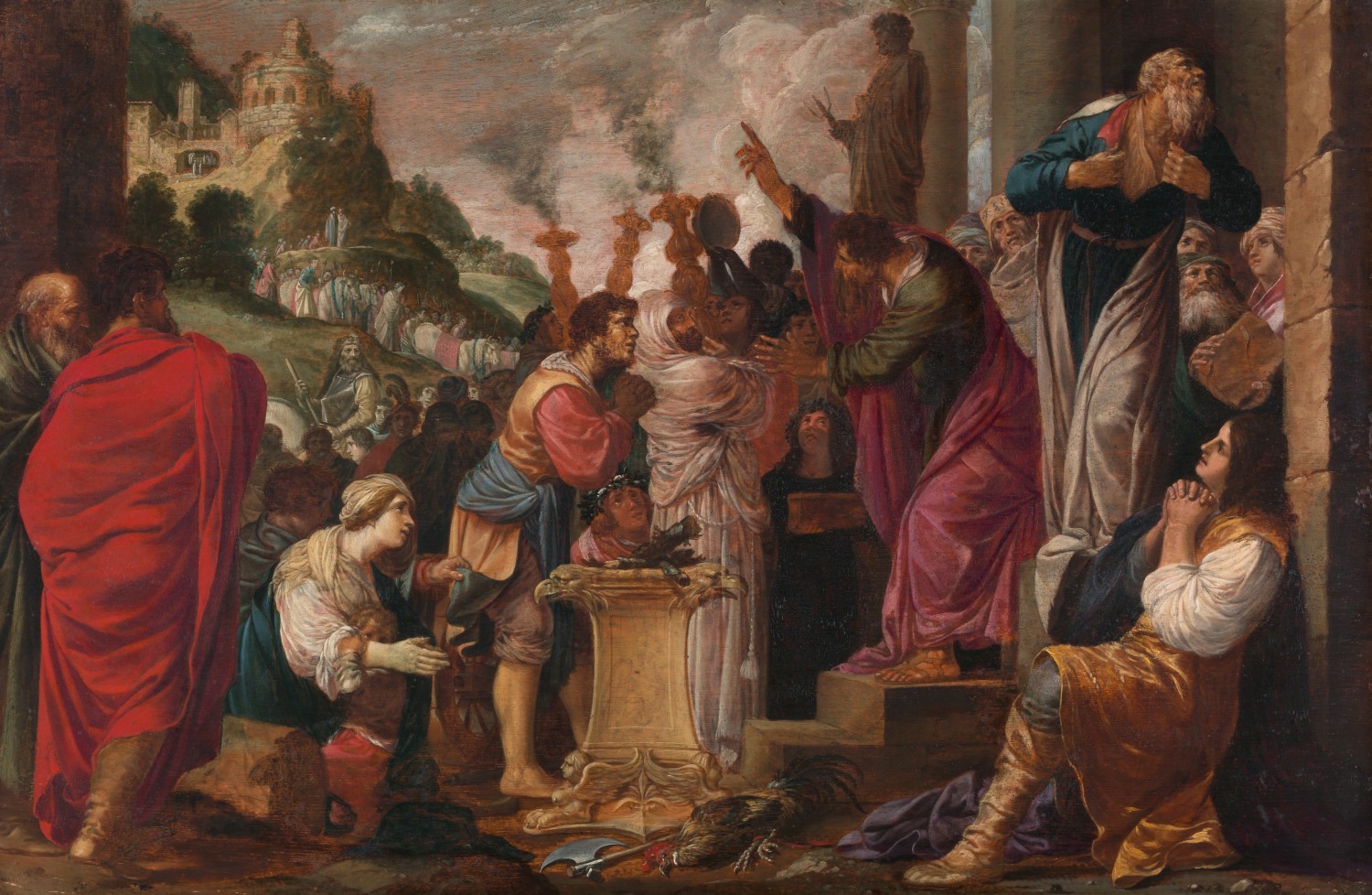
Paul and Barnabas at Lystra - Jacob Pynas (Dutch, Amsterdam 1592:93–after 1650 Amsterdam (?))


A few months ago, I wrote about some interesting allusions to the priest-poet Epimenides in the New Testament. I’d like to continue exploring non-scriptural literary influences and connections in the Bible with a look at a story from Ovid’s Metamorphoses
Publius Ovidius Naso was a Roman poet who lived from 43 BCE to about 17 of the Christian era. He wrote epic poetry in Latin, and his works have become a major source of information on Greco-Roman mythology. His magnum opus was Metamorphoses, a work spanning 15 books and containing some 250 mythic stories that encompass all of history, from creation to the death of Julius Caesar, within a frame narrative.


Hither Came Jupiter in the Guise of a Mortal…


What I am interested here is the story of Philemon and Baucis in Book VIII. A brief summary is as follows:
The gods Jupiter and Mercury visit Phrygia disguised as human travellers. They go from house to house in search of food and lodging, but are refused a thousand times. At last they come to the cottage of old Baucis and Philemon, who show the two visitors their finest hospitality despite their poverty. They prepare the finest meal they can muster, and are astonished at one point to see the wine replenishing itself. Realizing that their guests are divine, they attempt to offer their only goose as a sacrifice, but Jupiter and Mercury stop them. The two gods then pronounce judgment on the region for its wickedness, but make an exception for Baucis and Philemon. They lead the couple over to a nearby mountain and then watch while the entire countryside is flooded and their own house is transformed into a magnificent temple. The two gods then offer to grant Philemon and Baucis whatever they want, and the couple asks to serve as priests of the temple and to have their lives end at the same time. Years later, when the two die, they are immediately transformed into two sacred trees: an oak and a linden tree.
This tale, well-known in the ancient world, forms the basis for an episode in Acts. In chapter 14, Paul and Barnabas visit Lystra, a Roman colony not far from Phrygia. Paul heals a cripple, and when the crowds see it, they cry out that the gods have visited them, calling Barnabas Zeus and Paul Hermes. They attempt to offer sacrifices in honour of the visitors, but Barnabas and Paul angrily put a stop to it, insisting that they are mortals.
Zeus, of course, is the Greek name for Jupiter, and Hermes for Mercury. The basic idea, then, seems to be that the townsfolk of Lystra know the famous story about Jupiter and Mercury (Zeus and Hermes) travelling in the guise of mortals, and they jump to conclusions when they see Paul’s miracle. After all, they certainly don’t want to meet with the fate that the inhospitable villagers did in the story of Philemon and Baucis! But while Ovid’s visitors reveal their divine nature and accept hospitality, our two apostles reveal their mortal nature and refuse hospitality.
All commentaries agree on that much, more or less. There’s a bit more to it, however. Luther H. Martin in a paper published in New Testament Studies (see bibliography below) makes some important observations that most people miss. He notes that many commentators, “focusing on facticity rather than narrativicity,” fret over the difficulties of verse 11, which explicitly has the crowds speaking in Lycaonian. How did uneducated Lycaonian-speaking peasants communicate with the foreign apostles, and how likely is it they would have used the names Zeus or Hermes if they weren’t speaking Greek? (p. 153 n. 8)
Wrangling over such difficulties misses the point, however. Martin sees the author of Acts as a sophisticated writer with a “classical” perspective — and we have already seen his adroit use of the Epimenides legend. Acts was written to address a Greek audience, and their familiarity with traditions about Zeus and Hermes is all that really matters here. The parallels between Acts 14 and Philemon and Baucis go beyond a simple case of mistaken identity by the superstitious locals.
For starters, it is important to understand that Zeus and Hermes were “guarantors of emissaries and missions” in Greek tradition. (Cf. Plato, Leg. 941A.) It was considered a sin against Hermes and Zeus to deliver a false message. As Martin puts it, “Hermes guarantees that what is to be spoken is not ‘false messages’ but ‘good news’.” One of Zeus’s epitaphs was “giver of glad tidings”, while that of Hermes his messenger was “bringer of glad tidings”. (p. 155) It is no surprise then, that it is Paul who is made out to be Hermes because he is the main speaker and message bearer, delivering the Good News.
(Side note: There is also a problem if we ascribe the identification of Paul with Hermes to the Lystrans rather than to the author of Acts. Though inscriptions attest to the veneration of Zeus and Hermes in that area, these were apparently secondary names applied to a pair of local Luwian deities — Tarhunt, a weather god, and Runt, protector of wild animals — who did not possess the functions of king and messenger that are relevant to the author’s point. The actual residents of Lystra are unlikely to have made such a connection. See Versnel p. 42 for more on the subject.)
Another important parallel is the theme of hospitality. Just as Jupiter and Mercury visit a thousand homes before they find one that welcomes them, the hospitality offered by the Lystrans comes after Barnabas and Paul have been rejected at Antioch and Iconium. Zeus and Hermes are particularly relevant, as they were seen as patrons and protectors of travellers in foreign lands. (See Martin, p. 155 for numerous classical references.)
Thus, although the passage is ostensibly an entertaining account of mistaken identity, the author of Acts is actually placing his story “in the context of classical Greek tradition”, reinforcing the legitimacy and truth of the Christian mission to the Gentiles and reminding readers of their obligations regarding hospitality when receiving Christian missionaries. At the same time, the story reinforces a sharp contrast between the pagan and Christian views of deities. (p. 156)


....


Taken from: https://isthatinthebible.wordpress.com/2015/02/14/ovids-metamorphoses-and-the-gospel-according-to-hermes/